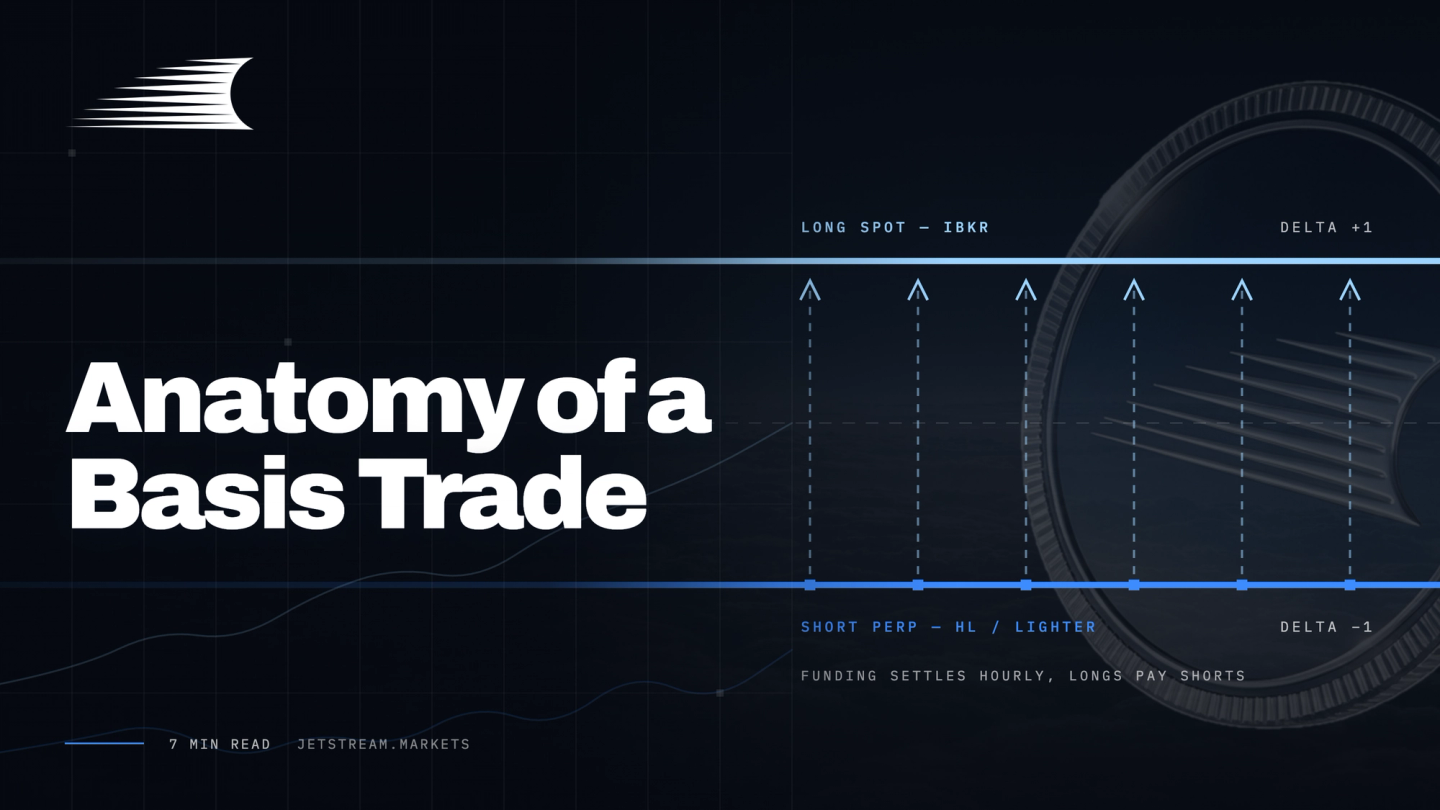
Anatomy of a basis trade
A basis trade is one of the oldest carry trades in finance, and one of the simplest to describe. You buy an asset and sell a derivative on the same asset for the same notional, then hold both sides until the derivative settles or until you choose to unwind. The price of the underlying can go anywhere in between without affecting your result. Your profit is the gap between what you paid for the spot and what the derivative pays you to be short.
In its 2026 form on crypto-native venues, the basis trade looks a little different on the surface. The derivative is a perpetual rather than a dated future, settlement happens every hour rather than at expiry, and the asset is increasingly a tokenised version of something that lives in TradFi: a single-name equity, a gold bar, a barrel of oil, an index. The underlying logic is unchanged. You own the thing, you owe the thing, and the market pays you to sit between the two.
This essay walks the trade end to end: what the two legs are, where the cash flows come from, what "delta-neutral" actually means and where it leaks, where the trade can hurt you, and how Jetstream's Global Basis+ fund is built to capture the carry while bounding the failure modes.
The two legs
The long leg is spot exposure to the underlying, and its concrete form depends on what the perp references and on what can actually be bought. For Global Basis+ the cash leg sits at Interactive Brokers, and tradable spot means US shares, US ETFs and Korean shares. Futures, currencies and index levels are excluded, which is why the basis sleeve concentrates on single-name equities and their ETF equivalents while commodity and index exposure is expressed through the cross-venue book. The choice of wrapper matters for funding cost, financing terms, and operational treatment, and we return to it below.
The short leg is the perpetual contract itself, a derivative without an expiry date whose payoff moves opposite to the underlying: if the price rises, the perp position loses, and if the price falls, the perp position gains. The notional on the short leg is sized to match the long leg as closely as the venue's tick sizes and margining allow. Global Basis+ runs that leg on Hyperliquid, Lighter, Coinbase International and Binance.
Set side by side, the two legs cancel directional price movement: if the stock rallies five percent, the share position gains five percent and the short perp loses five percent, and the net is zero before funding and financing. That cancellation is the whole point of the structure, because what remains once the directional move is hedged out is a stream of payments dictated by the perpetual itself.
Where the yield comes from
A perpetual contract has no expiry, which means it has no natural mechanism pulling its price toward the spot. Venues solve this with a funding rate. On Hyperliquid, Lighter and Coinbase the rate computes and settles hourly; Binance settles at intervals that convert to an hourly equivalent. The venue measures the gap between the perp's mark price and a reference index. If the perp is trading above the index, funding is positive: long positions pay short positions a fee proportional to the gap and to the notional held. If the perp is below the index, funding flips negative and shorts pay longs. The mechanic exists to keep the perp pinned to the underlying without an expiry to do the job.
In markets where retail demand is structurally long, perps trade above the index most of the time, so funding is structurally positive. The basis trader sits on the receiving end of that flow: long positions pay shorts every funding window, and the basis position is the short.
The size of that payment is what determines whether the trade is worth running. Between 1 January and 29 August 2026, 241 days, we tracked live funding across 205 ticker-venue combinations on Hyperliquid, Lighter, Coinbase International and Binance against tradable spot at Interactive Brokers, taking 595,450 hourly readings on the basis side and 606,147 on the cross-venue side. Ranking every trade each day by APR and keeping the twenty best, the short-perp / long-stock basis averaged 23.3% annualised, with the middle trade at 15.6% and the best five at 50.8%. Cross-venue funding pairs averaged 39.2%, with a median of 30.1% and the widest five at 73.4%.
The reference point that matters is what crypto pays. Over the same 241 days the best cash-and-carry available on BTC, ETH or SOL averaged 4.4%, with a best day of 15.7% and a worst day of −1.3%. Hyperliquid's own interest-rate floor sits at 5.5%. The tokenised-asset premium has been paying several multiples of the crypto floor all year.
Persistence matters as much as level. On an average day 97.5% of the twenty basis trades paid the short, all twenty paid on 94.2% of days, and that share reaches 100% from May 2026 onward. Measured per trade rather than per day, trades that reached a top twenty on at least ten days were paid in a median 74% of hours. By venue, the median share of hours the short got paid was 96% on Lighter, 82% on Hyperliquid, 75% on Coinbase and 18% on Binance, which is why Binance functions as a cross-venue counterweight rather than a home for the basis leg.
All of these figures are gross, before fees, borrow, slippage and commissions, and they describe a daily top twenty selected out of the full universe. Most listed tickers pay far less. Past funding does not predict future funding.
What "delta-neutral" really means
The phrase is precise. Delta is the sensitivity of the position to a one-unit move in the underlying, and a long spot leg has delta close to plus one while a perfectly sized short perp leg has delta close to minus one. Their sum is approximately zero, which is to say the combined position is approximately indifferent to price.
The word "approximately" is doing work. Real positions drift away from zero for a handful of reasons: funding payments arrive in cash and change the dollar size of one leg relative to the other, the perp's mark price diverges from the spot index inside a window, tokenised wrappers can trade at small premiums or discounts to their underlying, and borrow costs on the spot side accrue against the position. Delta has to be managed continuously or it reappears.
Global Basis+ manages it at the order level rather than by periodic sweep. Legs are matched in USD notional with a target net delta of zero. Every venue child order is an immediate-or-cancel limit placed within 25bps of the live book mid, so nothing rests on the book and nothing walks it. The per-child delta target is 25bps of that child, and the engine sends correctives and then a reduce on the leader to get inside that aim. Residual past 1% of requested gross parks the position: increases stop, an approved reduce or close stays available, and an operator resolves it. On any reduce or close the engine fills the leader first and sizes the follower to what the leader actually filled. Each leg is pinned to 1x isolated before the first child order, so fund-level leverage is zero.
It is worth being exact about what is automatic and what is not. The engine enforces the order-level controls above without a human in the loop. Delta rebalancing of the smaller leg, unwinding a filled first leg after a timing gap, funding-floor rejects at the router, and NAV drawdown halts are currently monitor-flagged and executed on operator approval. No drawdown threshold in the engine triggers an automatic unwind today. Describing those as live automation would overstate what has shipped.
Where the trade goes wrong
A basis trade has no directional exposure, which makes its failure modes structural, and four of them are worth naming in turn.
The first is venue risk. Both legs need a venue capable of paying out at scale, because a perpetual that cannot be unwound or a spot venue that halts withdrawals traps capital on one side and leaves the other side hedged against nothing. Global Basis+ weights venues by how battle-tested they are, available liquidity, and internal due diligence: offchain, Interactive Brokers is the most robust name in the mix, and onchain, Hyperliquid and Coinbase are. There is a second layer specific to these markets. Hyperliquid's equity and commodity perps are listed under HIP-3 by third-party deployers, principally Trade.xyz, so the deployer controls the oracle blend, the liquidity and the fee design. Deployer stake, oracle latency, funding caps and market-closed oracle behaviour are all monitored as named risks, and new Hyperliquid exposure is capped if the deployer looks stressed. Rollup transfers use canonical platform bridges, whitelisted and fixed in code.
The second is funding inversion, where a persistently long market flips short under stress and a position designed to collect positive funding starts paying it instead. Global Basis+ runs an internal adverse-carry signal on open positions. The monitor flags; an operator approves the rebalance or close.
The third is concentration, the risk that a book earning its carry from one ticker is one tick of bad news away from a forced unwind. No single trade may exceed 35% of the book. The fund also screens so that it never becomes a material fraction of a ticker's open interest or visible depth, and if the eligible universe shrinks, deployment is reduced rather than concentrated further. At the fund level, a 3% drawdown from the high-water mark opens the risk-off band: new risk halts and the weakest pairs are cut. An 8% drawdown is a hard stop and full unwind with immediate investor notification. Redeployment after either requires CIO and risk review.
The fourth is operational. Custody, key management, and counterparty exposure are where institutional basis books historically failed in 2022 and again in 2023. Global Basis+ holds all capital in a Fireblocks MPC vault with Ascent GFS, the fund administrator, sitting on the accounts as an independent third-party signer. A Transaction Authorisation Policy governs destination whitelists, per-asset velocity caps and transaction vetoes, and the engine cannot create a whitelist entry. The onchain vault contract has exactly one permitted destination. Venue keys can do two things, trade or return capital to the vault, with withdrawal destinations pinned at the protocol level. Hyperliquid and Lighter keys are generated and used only inside an attested AWS Nitro enclave that re-checks leg, side, price and size against a signed parent authorisation before it will sign an order, and the decryption key is released only to an enclave whose measured image matches the approved value. Emergency functions carry 48-hour timelocks, and an independent watchdog agent reconciles onchain and venue balances against the signer's own log, alarming on any discrepancy.
On the contract side, Pashov Audit Group reviewed Jetstream in April 2026 and returned 25 findings: two critical, five medium and eighteen low. The criticals covered a redemption-funding accounting gap and an incorrect yield-fee calculation. All 25 were resolved and the fixes re-audited. Neither critical would at any point have enabled user funds to leave Jetstream or resulted in a loss of funds. The full report is in the data room.
Why the carry exists today
A trade is interesting because it pays, and it is investable because someone is willing to pay it. In tokenised RWA perps as of Q3 2026 that someone is retail, drawn by twenty-four-hour leverage on familiar assets available through a self-custodial wallet, and the resulting directional flow has outpaced what short-side capital has been able to absorb. The cohort that can underwrite both the global asset and the onchain venue is small, which is the structural reason funding has stayed sharply positive.
The 2026 data shows the premium holding rather than fading. The basis average moved from 23.3% across the year to 24.8% over the eight weeks ending 29 August. The cross-venue average did compress, from 39.2% to 28.6%, which is still roughly five times the crypto floor.
That gap is also why the window is finite. As shorts arrive, meaning regulated funds with the right wrapper, prime brokers with the right rails, and market makers with the right risk limits, funding rates compress and the trade reverts toward a thinner version of itself. The crypto-native basis trade took four years to crowd out. The tokenised RWA version sits closer to its early innings, with a harvestable phase best measured in quarters.
What Jetstream is building
Global Basis+ is the institutional wrapper around the trade described above. The fund is a Cayman-domiciled, CIMA-licensed private fund managed by Jetstream Capital Partners, a BVI Approved Investment Manager and SEC Exempt Reporting Adviser, targeting 16%+ net annualised with zero directional exposure and zero leverage. Rankin Berkower is fund auditor and Ascent GFS is administrator.
Allocators access it by minting USDJ, the onchain receipt token representing interests in the underlying fund. Deposits enter an ERC-4626 vault whose only permitted destination is the Fireblocks vault, and KYC, KYB and accreditation run through Ascent GFS. Initial capacity is $30M. Subscriptions are open on a rolling basis and swept into strategy weekly, with monthly withdrawal epochs. Fees are 2% on AUM and a tiered performance fee of 15% on gross returns up to 16% and 25% above it. Vault TVL, performance, venue allocations and risk-policy compliance stream to a public dashboard in real time; those live figures are unaudited, and the monthly auditor-certified NAV from Rankin Berkower is the official valuation wherever the two differ.
The trade itself has been understood for decades. What is new is the wrapper around it and the markets it now reaches, and the combination of those two is what makes the current opportunity worth structuring around.
For professional and accredited investors only. Access is subject to KYC, accreditation and jurisdictional eligibility determined by the Fund and its administrator; subscriptions from OFAC-sanctioned and other restricted jurisdictions are prohibited. In Hong Kong this material is directed only at professional investors within Schedule 1 of the SFO (Cap. 571). Not SFC-authorised. Strictly private and confidential. This is not an offer or solicitation. All terms are indicative and subject to finalisation in the Offering Documents, which prevail over anything stated here. Funding figures shown are gross, historical, and describe a selected daily top twenty. Targets are not guarantees and past performance is not indicative of future results.